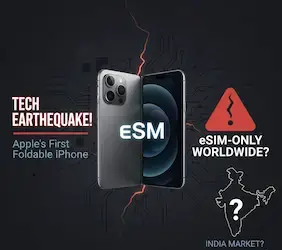
The rumour mill surrounding the iPhone Fold—Apple’s long-awaited, sure-to-be-expensive foldable device—has just dropped a bombshell that could completely reshape how we use phones across the globe.
According to a new report, Apple’s first foldable iPhone could be eSIM-only worldwide when it launches in late 2026. This aggressive eSIM-only move would mean completely ditching the decades-old physical SIM card tray, not just in select regions, but globally.
While Apple has already pulled the physical SIM tray from its flagship models in the US, extending this to a globally released, ultra-premium device like the iPhone Fold signals that the Cupertino giant is ready to force the entire world into the digital future—a move that is guaranteed to cause headaches in major Asian markets, including the crucial India market.
The Design Dilemma: Why the Physical SIM Is Doomed
Why is Apple rushing to kill the tiny SIM tray now? The answer lies in the engineering challenge of creating a foldable device that meets Apple’s exacting standards for thinness and durability.
- Space is King: Foldable phones are engineering marvels, but internal space is severely constrained by the folding mechanism and hinges. Ditching the physical SIM tray frees up precious internal space. This space can then be used for more critical components, such as a larger battery (a necessity for foldable phones) or a more sophisticated camera system.
- The Ultra-Thin Goal: The iPhone Fold is rumored to feature a sleek, book-style design that opens to a 7.8-inch screen, reminiscent of a miniature iPad. Analyst reports suggest its folded thickness will be exceptionally thin. To achieve this ultra-slim profile, compromises must be made, and the bulky mechanical SIM tray is an easy target.
- Durability Boost: Removing the SIM slot eliminates one of the few open ports on the phone, improving dust and water resistance and simplifying the overall design—a crucial factor for a complicated mechanism like a foldable.
This eSIM-only move is not a sudden decision; it’s the logical next step after the iPhone 15 in the US went SIM-less, and the subsequent ultra-thin iPhone Air was launched without a tray. The iPhone Fold is just the latest, and most expensive, product to confirm Apple’s vision for a fully digital future.
The Controversial Flip: Global Chaos Awaits
While Western markets are generally ready, the global eSIM rollout is far from seamless, leading to a potential consumer backlash that could dampen the iPhone Fold’s success, particularly in China and other Asian nations.
- China’s Resistance: In China, users strongly prefer the physical SIM card for two main reasons: seamless dual-SIM use and the fast resale market. Quick SIM swapping is essential for people who frequently change phones or want to run business numbers. Crucially, eSIM activation in mainland China often still requires an in-store visit to the carrier, defeating the convenience of the digital setup.
- The Travel Nightmare: Many everyday people who travel frequently rely on buying local physical SIMs for cheaper data. Forcing them onto eSIMs complicates this process, requiring tourists to rely on carrier apps or complicated international roaming plans.
The eSIM-only move will force consumers to adapt, whether they are ready or not, and this friction could slow adoption outside of Apple’s most loyal customer base.
The India Market Readiness: Smooth Sail or Stumble?
The biggest question for readers in India is: will the iPhone Fold be a headache here?
Fortunately, the India market is better positioned for this change than many other countries. Major local carriers, including Jio, Airtel, and Vi, already offer robust support for eSIM activation. This process can typically be completed online or through a carrier app, meaning consumers do not need to rush to a physical store every time they buy a new phone.
However, the adaptation is not zero. Even with smooth activation, users who frequently use two numbers (a common practice in India) will have to rely solely on the eSIM’s dual-number capability, and the resale value may take a temporary hit until the market fully normalizes the lack of a physical SIM card tray.
The Flagship Features You’ll Pay For
If you are paying the anticipated price tag (rumoured to be over ₹2,00,000 in India), you are buying more than just a folding screen. The iPhone Fold is expected to be a technical masterpiece:
- Crease-Free Display: Apple is reportedly solving the visible crease issue that plagues current foldables.
- A20 Pro Chip: Running on the next-generation A20 Pro chip, it will deliver unmatched performance.
- Advanced Cameras: It’s expected to feature a 24MP under-display camera for the selfie lens and advanced dual rear cameras.
- Touch ID: Rumours suggest it might use the more space-efficient Touch ID for authentication, rather than Face ID.
The iPhone Fold is poised to be a symbol of luxury and innovation. But the decision to go all-in on eSIM is the clearest sign yet that Apple is willing to risk a little market turbulence to fully usher in the next era of digital, seamless connectivity. The future is folding, and it’s SIM-free.

Anushka is an automotive writer with three years of experience creating reviews, features, and technical guides. Passionate about cars, she translates complex engineering details into engaging, reader-friendly content. Covering market trends, safety innovations, and electric-vehicle advancements, Anushka delivers insightful, trustworthy articles that fuel readers’ passion for the open road.