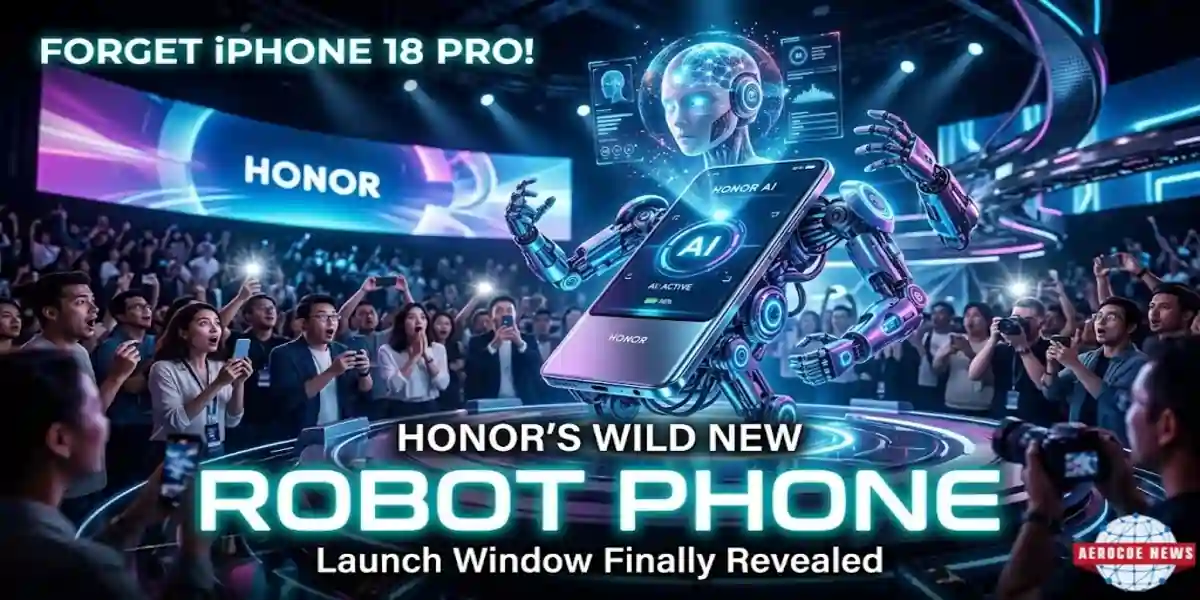

For the past few years, the mobile industry has felt slightly predictable. Wave after wave of flagship releases have hit the market, each offering the standard incremental updates: a slightly faster processor, a brighter display, and a minor camera sensor upgrade. The classic form factor has remained largely a static sheet of glass and metal. However, Honor is completely disrupting this design monotony with the wildest hardware concept of the year. The company has officially confirmed the release timeline for its highly anticipated and deeply unconventional “Robot Phone,” proving that this futuristic Smart Phone is a tangible product coming to store shelves.
First teased as an abstract concept that felt almost too futuristic to be true, Honor has spent months validating the project through public demonstrations. Following a major showcase at the Mobile World Congress (MWC) in Barcelona, Honor brought the physical device to the glitz and glamour of the Cannes Film Festival. This move was highly intentional, allowing filmmakers, creators, and tech enthusiasts to interact with the hardware firsthand. Along with the hands-on experience, the company solidified its release plans, establishing a launch window that puts it on a direct collision course with the tech industry’s biggest legacy giants.
The Q3 Launch Timeline: A High-Stakes Autumn Showdown
Honor has officially confirmed that the Robot Phone will make its commercial debut during the third quarter (Q3) of this year. This window places the launch somewhere between July and September, a period traditionally recognized as the most competitive window in the consumer tech calendar.
While a specific day has not yet been locked in, launching a disruptive device during this period is a bold, strategic statement. Early September is typically dominated by Apple’s annual hardware event, where the iPhone 18 Pro and the heavily rumored foldable iPhone Ultra are expected to take center stage. By positioning its launch in the identical timeframe, Honor is sending a clear message: consumers looking for true hardware innovation should look beyond the usual iterative upgrades of standard flagships.
Hollywood Tech in Your Pocket: The ARRI Image Science Collaboration
The most significant technical revelation surrounding the Robot Phone is Honor’s formal partnership with ARRI, the legendary German manufacturer of professional motion picture equipment. If you have watched an Oscar-winning film or a high-end streaming series over the last few decades, chances are it was shot on an ARRI Alexa camera system.
Through this strategic collaboration, the Robot Phone will serve as the first consumer-grade hardware to integrate elements of ARRI Image Science directly into its internal processing. While exact software specifications remain tightly guarded, this implies a massive leap forward in color management, dynamic range, highlight roll-off, and skin tone reproduction. Instead of relying on hyper-processed, artificial-looking AI filters common in modern mobile photography, Honor aims to deliver a genuinely cinematic, film-like aesthetic out of the box.
Mechanical Ingenuity: The 4DoF Built-In Gimbal System
The “robotic” element of this Smart Phone is not just a marketing buzzword; it is a profound mechanical reality. The device features an integrated, ultracompact 4DoF (Four Degrees of Freedom) gimbal system built directly into the chassis.
Why a Built-In Gimbal Changes the Game
While standard premium mobile devices rely heavily on Optical Image Stabilization (OIS) or aggressive Electronic Image Stabilization (EIS) that crops into the video frame, Honor’s mechanical gimbal physically moves the camera sensor to counteract hand tremors and rapid motion.
- Robotic-Grade Control: The 4DoF system provides complex, stabilized tracking shots that mimic professional Hollywood camera rigs.
- Zero Quality Loss: Because the stabilization is purely mechanical, the sensor captures the entire uncropped resolution of the lens, maximizing low-light performance and detail.
- Autonomous Tracking: The motorized system can automatically pan and tilt to keep human subjects perfectly centered in the frame without requiring a tripod or external accessories.
The Concept Shift: From Emotional Companion to Cinema Powerhouse
It is worth noting how the narrative surrounding this device has evolved over its developmental cycle. Honor’s initial AI-generated teasers and concept art portrayed the Robot Phone as a living, breathing emotional companion. Early marketing materials suggested a device that could autonomously scan its environment, react to human emotions, and behave almost like a digital pet.
However, the latest announcements from the Cannes Film Festival indicate that Honor has smartly grounded the product in practical utility. The ethereal “emotional companion” concept has taken a backseat to a highly focused, professional-grade filmmaking tool. By emphasizing the groundbreaking video capabilities and mechanical stabilization over abstract AI personas, Honor is targeting a highly lucrative demographic: mobile journalists, vloggers, and independent filmmakers who demand maximum cinematic capability without carrying heavy gear bag setups.
Navigating the Q3 Gauntlet: The Competitive Landscape
Launching a highly experimental Smart Phone into the premium market is an incredibly risky endeavor, especially given the fierce competition lined up for the summer and autumn months. Honor will have to fight for consumer attention against established tech empires:
- July: Samsung is expected to refresh its lineup with the Galaxy Z Fold 8, the Z Flip 8, and a brand-new ultra-premium variant rumored to be called the Z Fold 8 Wide.
- August: Google is slated to drop its highly anticipated Pixel 11 series, relying heavily on deeply integrated, next-generation Gemini AI features.
- September: Apple will dominate mainstream headlines with the rollout of the iPhone 18 Pro series and its first-ever flagship foldable alternative.
Comprehensive Market Analysis: How the Major Flagships Compare
To see how Honor’s bold approach stacks up against the upcoming industry standards, let’s look at the projected competitive landscape:
| Feature/Specification | Honor Robot Phone | Apple iPhone 18 Pro | Samsung Galaxy Z Fold 8 |
| Primary Innovation | Physical 4DoF Mechanical Gimbal | Iterative Sensor Upgrade & Variable Aperture | Flexible Foldable Display Architecture |
| Color/Imaging Science | ARRI Professional Cinema Science | Apple Smart HDR / ProRAW Processing | Samsung Natural Scene Optimizer AI |
| Form Factor Risk | Moving mechanical parts inside chassis | Highly durable, static design profile | Hinge wear and inner screen crease management |
| Primary Target Audience | Indie Filmmakers & Elite Content Creators | Mainstream Premium Users & Pro Photographers | Multi-tasking Professionals & Power Users |
Gimmick or the Future of Mobile Hardware?
Whenever a company introduces moving mechanical components into a mobile chassis, critics will inevitably raise the “gimmick” flag. Mechanical parts introduce potential failure points, increase power consumption, and complicate water and dust resistance ratings.
However, history has shown that today’s wild experimentation often paves the way for tomorrow’s industry standards. Even if the Robot Phone does not immediately achieve mainstream commercial dominance, its existence is vital for the ecosystem. It pushes boundaries, forces rivals to rethink their design approaches, and offers an incredibly exciting, tangible alternative for early adopters who are genuinely bored by the lack of physical innovation in standard devices.
Conclusion: A Bold Leap Worth Watching
Honor’s upcoming Robot Phone is a fascinating testament to what happens when hardware engineers are allowed to think outside the box. By combining professional Hollywood color tuning via ARRI with a robust, automated 4DoF mechanical gimbal, Honor is creating a specialized powerhouse that stands completely separate from the competition. While Apple and Samsung focus on refining their existing designs, Honor is taking a massive leap into unmapped territory.
Whether it becomes a niche tool for specialized creators or sparks a brand-new design trend for the entire industry remains to be seen. One thing is certain: the autumn premium hardware battle will be anything but boring.
Would you trade the predictability of a traditional flagship for a device with a built-in mechanical gimbal system? Let us know your thoughts in the comment section below, and don’t forget to share this article with your fellow tech enthusiasts!
Frequently Asked Questions (FAQs)
Q1: What exactly makes the Honor device a “Robot Phone”?
The device is called a Robot Phone because it integrates a motorized, mechanical 4DoF (Four Degrees of Freedom) gimbal system inside the chassis. This allows the camera to physically pan, tilt, and track subjects autonomously, utilizing robotic-grade motion control rather than purely digital stabilization algorithms.
Q2: When will the Honor Robot Phone be officially released?
Honor has confirmed that the global launch will take place during Q3 of this year, which means the device will officially hit the market sometime between July and September.
Q3: What does the partnership with ARRI bring to this Smart Phone?
ARRI is the industry-standard provider of professional Hollywood cinema cameras. The partnership integrates ARRI Image Science directly into the phone’s processing pipeline, offering cinematic color accuracy, film-grade dynamic range, and natural skin tone rendering that avoids the over-processed look of typical mobile filters.
Q4: How does a mechanical gimbal compare to standard Optical Image Stabilization (OIS)?
Standard OIS can only compensate for minor hand tremors by shifting the lens slightly. A 4DoF mechanical gimbal can rotate across multiple axes, allowing for dramatic tracking shots, seamless pans, and robust stabilization during active running or walking without dropping video resolution.
Q5: Will the mechanical parts affect the durability of the phone?
While moving parts inherently introduce potential wear and tear points over time, Honor has extensively stress-tested the device during public demonstrations at MWC and Cannes to ensure that the internal motor structures can comfortably withstand the rigors of daily handling.